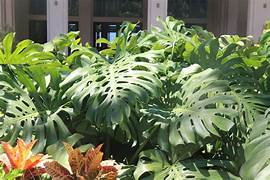
Here are the main care requirements for growing a monstera deliciosa:
- Requires warmth and humidity; can plant outdoors in USDA zones 10 through 12.
- Prefers partial sun or dappled light.
- Needs acidic or neutral, peat-based, well-draining soil.
- Use a pot with ample drainage holes and water regularly.
- Give balanced fertilizer three to four times per year.
Light Requirements
Monstera deliciosa thrives in bright, indirect light — ideally 6 or more hours per day. An east-facing window is ideal: it provides gentle morning sun without the intense afternoon heat. North-facing windows work but may slow growth. South and west-facing windows can work well if the plant is set back a few feet or filtered with a sheer curtain.
Too little light: growth slows dramatically, new leaves stay small, and fenestration is minimal or absent. Too much direct sun: the large leaves scorch easily, developing brown crispy patches that will not recover. If your Monstera has been in low light and you want to move it to brighter conditions, transition it gradually over 2-3 weeks.
How Much Sunlight Do Monstera Plants Need?
As a houseplant, monsteras need bright, indirect sunlight, and prefer not to be in the direct sunlight for too long, especially in summer. Direct sunlight can burn the leaves.
If you don’t think your monstera is getting enough light, you can install a grow light to encourage better growth.
If you are keeping your monstera outside, place it in full shade or partial shade, as this mimics its natural environment in woodlands and forests.
What Type of Potting Soil Is Best for Monsteras?
Monsteras like evenly moist, well-draining potting soils when grown as a houseplant. The best soil for monsteras will also have amendments, like perlite and shredded bark, which help with the plant’s drainage and aeration.
You can achieve this by mixing together three parts indoor houseplant soil, two parts shredded bark, and one part perlite.
Grown in its native environment, monstera deliciosa likes lightly sandy, medium loamy, and heavy clay soils with acid or neutral pH.
How Should I Water a Monstera Deliciosa?
You should water a monstera whenever the top few inches of soil are dry, which you can test with your finger.
If your monstera needs water, be sure to water it slowly and deeply until water runs out of the drainage holes in the bottom of the pot.
Avoid keeping your plant’s soil moist all the time, as this can cause root rot. Instead, let it dry out between waterings. You can tell your monstera needs water if the leaves look droopy or are starting to curl.
Monstera has different watering needs in summer and winter. In summer, when it’s actively growing, water it once a week. In the dormant season, winter, you can switch to a once every two or three week schedule.
What Temperature and Humidity Do Monsteras Need?
Monstera deliciosa prefers temperatures between 65°F and 85°F. It can tolerate temperatures down to 50°F and up to 90°F but will stop growing at these extremes. It prefers high humidity, about 60%. To increase humidity indoors, add a humidifier.
Do I Need to Fertilize a Monstera Deliciosa?
Monstera deliciosas need to be fertilized every few weeks during the growing season. To fertilize a monstera deliciosa, choose a balanced liquid fertilizer with a 1-1-1 ratio or a 3-1-2 ratio. Dissolve the fertilizer in water and give it to the plant in place of a usual watering.
Adding a grow light is one of the best ways to get monstera leaves to split into fenestrations. Give your monstera plenty of light, water when the top inch or so of soil is dry, and fertilize regularly to support its growth.
Pruning
Aerial roots may seem weird but they are a normal feature of the plant that grows as it seeks moisture and something to grow up. Try providing it with a moss pole. The only pruning the plant needs would be to keep the size under control. You can propagate any cuttings to make a new plant for yourself or to give to a friend.
Propagating Monstera Deliciosa
Monstera deliciosa can be easily propagated by stem cuttings from pruning. However, the most popular method of propagating Monstera deliciosa is air layering. Here are the steps for both method.